Saturday, 31 August 2013

Mandevilla Diamantina® “Opale Citrine”


The genus Mandevilla belongs to the family Apocynacea which includes mostly tropical and subtropical vines. Most of the roughly 100 species are native to the South-western United States, Mexico, Central America and South America. The genus was named after Henry Mandeville (1773-1861), a British diplomat and gardener. (http://en.wikipedia.org/wiki/Mandevilla).
Many hybrids have been developed; most of them have red, pink or white flowers:
http://www.lannes.pro/fr/dipladenia_diamantina_professionnels/collection_dipladenia_diamantina.htm
Yellow varieties like “Opale Citrine” are rare. The flowers of this variety are huge with a diameter of 8-9 cm.

The plant was purchased from a florist, Germany July 2013, and photographed on 24 August 2013.

The flowers show a very prominent UV-signature with a dark centre area and a very reflective circle around the nectaries. The UV-dark area appears orange in visible light and the central UV-bright ring appears white when illuminated with visible light. The latter fact can be hardly seen in the image below, because it is shaded inside the flower.

Visible light: Panasonic Lumix G1, broadband modified; EL-Nikkor 80 mm/f5.6 at ~f11. Baader UV/IR cut filter.

Image reference: CHA_P1100930_130824


Ultraviolet light: Panasonic Lumix G1, broadband-modified; EL-Nikkor 80 mm/f5.6 at f8. Baader U2" (Venus) filter, UV flash: “MR21N”.

Image reference: CHA_P1100933_130824

Thursday, 18 July 2013

Large-flowered Evening Primrose (Oenothera glazioviana Micheli): UV-reflexion, simulated bee-colours and UV-induced fluorescence.

The genus Oenothera is mainly native in America. Several species have been brought to Europe as ornamental plants and some have escaped from there. Interestingly, there are stable hybrids in Europe that are not found in America. The species O. glazioviana is probably a hybrid that emerged in Europe. In contrast to most other Oenothera species O. glazioviana (http://de.wikipedia.org/wiki/Rotkelchige_Nachtkerze) does not seem to be self-pollinating.
The species was determined with the following key: http://www.bvnh.de/bnh/bestimm/gatto/oenothera.html

Plants were collected in Bensheim, Germany July 2013  (growing in the garden of the author, as a weed).

The flowers show a very prominent UV-signature with a dark centre and dark veins while the outer parts of the petals show a strong UV reflexion. In the simulated bee-colours the petals appear bee-magenta (green plus UV) with a bee-red centre (only green reflexion), while the pollen is bee-yellow (reflecting green and blue but no UV). – Interestingly, the UV-signature becomes also visible to the human eye when the flowers are illuminated with a UV torch (see induces fluorescence image).

 
Visible light: Panasonic Lumix G1, broadband modified, EL-Nikkor 80 mm/f5.6 at f8.

Ultraviolet light: Panasonic Lumix G1, broadband-modified, EL-Nikkor 80 mm/f5.6 at f8. Baader U2" (Venus) filter, flash: “UV flash-it”. 

Monday, 8 July 2013

Butterfly: Marbled White (Melanargia galathea L.)


Marbled White (M. galathea) is a common butterfly species in central Europe found on meadows that are not farmed to intensively.
UV-photos of butterflies are challenging, since UV-captures normally require a tripod, manual focusing and exposure times that are too long for moving subjects. In this case I was out at sunset when this species was already sitting at the sleeping positions in the vegetation. Nevertheless, all attempts to capture an image with available light resulted in heavy motion-blur.

Photographed near Tauberbischofsheim, Germany  6 June 2013.

I have not captured or seen many UV images of butterflies, so far. 
In M. galathea the overall UV-reflexion of the wings is pretty weak and shows less contrast than in visible light. However, the blue dots are an exception in being very UV-bright, forming a strong contrast to the surrounding wing.

Images were taken with a broadband-modified Panasonic Lumix G1 and the EL-Nikkor 80mm/f5.6 at f5.6.


Visible light image with Baader UV/IR-blocking-filter, ISO 100


UV-image, Baader U-filter 2”, ISO 400, UV-flash:


Since many butterfly species can see UV light it is not unlikely that there are more species with distinct UV pattern on their wings.


Tuesday, 25 June 2013

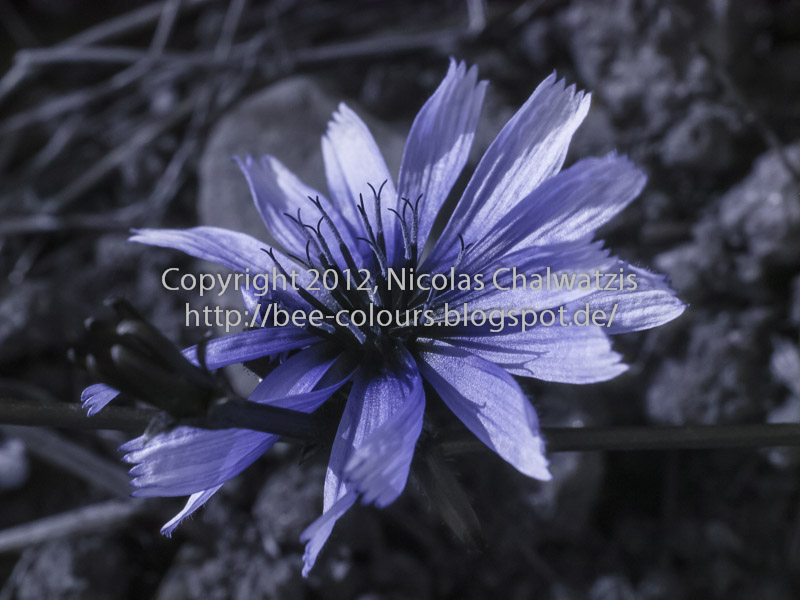
Cichorium intybus L. (Asteraceae). Common Chicory. Flowers photographed in visible and ultraviolet light, including simulated bee colours.

This is the wild form of the vegetable chicory. It is common along streets and paths.

Flowers were photographed near Bensheim, Germany 15 October 2012.

All images were taken with a broadband-modified Panasonic Lumix G1 and the EL-Nikkor 80mm/f5.6 at f8.


Visible light image with IR-neutralisation-filter ND (Optic Makario), ISO 100:

image reference: NCH_P1060273_120918


UV-image, Baader U-filter 2”, ISO 400, sunlight

image reference: NCH_P1060276_120918


“simulated bee-colours”: composite image of the greyscale converted UV image (-> blue) and the blue (-> green) and green (-> red) channel of the visible light image. The goal of this is to mimic the spectrum that bees and other insect-pollinators can see.
 

image reference: NCH_P1060275_RGB_sw_121015


Interestingly, the petals that appear blue with white centre parts in visible light are UV-dark in the center and get UV-brighter towards the tips. The filaments are also very UV-dark.
The simulated bee colours show a prominent bee-yellow centre that guides the pollinators.

Wednesday, 19 June 2013

Bryonia dioica Jacq. (Cucurbitaceae). White Bryony. Male and female flowers photographed in visible and ultraviolet light.

Bryonia dioica Jacq. (Cucurbitaceae). White Bryony. Male and female flowers photographed in visible and ultraviolet light.
Only few species of the family Curcurbitaceae are found in central Europe. B. dioica is probably the most common of them. As the Latin name indicates the plants have either only male or only female flowers. These are mostly pollinated by the bee Andrena florea that feeds only on Bryonia species. In the river Rhine valley, at least in the greater Frankfurt area, both species (bee and plant) are quite common. Female flowers are significantly smaller compared to the male flowers. The later berry is already visible.
 

Male flowers were photographed near Bensheim, Germany 8 May 2013.
Female flowers were photographed near Bensheim, Germany 13 May 2013.


All images were taken with a broadband-modified Panasonic Lumix G1 and the EL-Nikkor 80mm/f5.6 at f8-11.


Male flower: Visible light image with IR-neutralisation-filter ND (Optic Makario), ISO 100

image reference: NCH_P1090133_130608


Male flower: UV-image, Baader U-filter 2”, ISO 400, sunlight
image reference: NCH_P1090136_130608


Male flower: Visible light image with IR-neutralisation-filter ND (Optic Makario), ISO 100
image reference: NCH_P1090142_130608  

 Male flower: UV-image, Baader U-filter 2”, ISO 400, sunlight
image reference: NCH_P1090142_130608


Female flower: Visible light image with IR-neutralisation-filter ND (Optic Makario), ISO 100
image reference: NCH_P1090265_130613

 
Female flower: UV-image, Baader U-filter 2”, ISO 400, sunlight
image reference: NCH_P1090262_130613
 

In both genders the petals are quite UV-reflective. The green veins and inner parts of the flowers are UV-dark.